

Why Pumped Storage
As the UK System transitions from being dominated by 'on-demand' thermal generation to intermittent renewables, it becomes increasingly difficult to balance electricity supply and demand.
Energy storage enables electricity generated during periods of surplus renewable production, primarily from wind, to be stored and released later when renewable output is lower. Pumped storage hydro (PSH) schemes operate in effect as very large batteries, storing energy for use when it is needed most.
Pumped Storage Hydro (PSH) is a mature and proven technology with an operational lifespan of more than 100 years. It can deliver large-scale energy storage over long durations and does so at a competitively low cost per unit of power capacity and stored energy compared with many alternative technologies.
Investment in PSH capacity will support the continued expansion of renewable energy across the UK electricity system, helping to reduce reliance on expensive, carbon-intensive gas generation. In turn, this will accelerate the transition to a cleaner, low-carbon economy and contribute to Scotland’s target of achieving net zero emissions by 2045. It will also strengthen energy security by reducing exposure to global events and volatility in international energy markets, such as recent conflicts in the Middle East.
The Earba PSH project is intended to be the first of several pumped storage hydro developments that we plan to bring forward in the coming years.

WHY PUMPED STORAGE HYDRO ‘PSH’?

WHY PUMPED STORAGE HYDRO ‘PSH’?
Energy storage allows energy generated during times of excess demand (mainly wind and solar) to be stored and released later when there is a deficit of renewable energy. Pumped Storage Hydro ‘PSH’ projects are in effect very big batteries.
PSH is a mature, proven, long-lifespan (100yr+) technology which has the ability to deliver large capacities of energy storage for long durations. The energy can be delivered at a competitively low cost per unit of power capacity and per unit of energy stored when compared with other technologies.
By developing and investing in PSH capacity, we are helping more renewables to be added to the UK System, displacing expensive and carbon-emitting gas generation and ultimately speeding up the transition to a clean, carbon-free economy and helping to meet Scotland’s climate change target of net zero by 2045.
The Earba PSH project is the first in line of a number of PSH projects which we plan to develop in the near future.
Quantifying the Long Duration Energy Storage opportunity
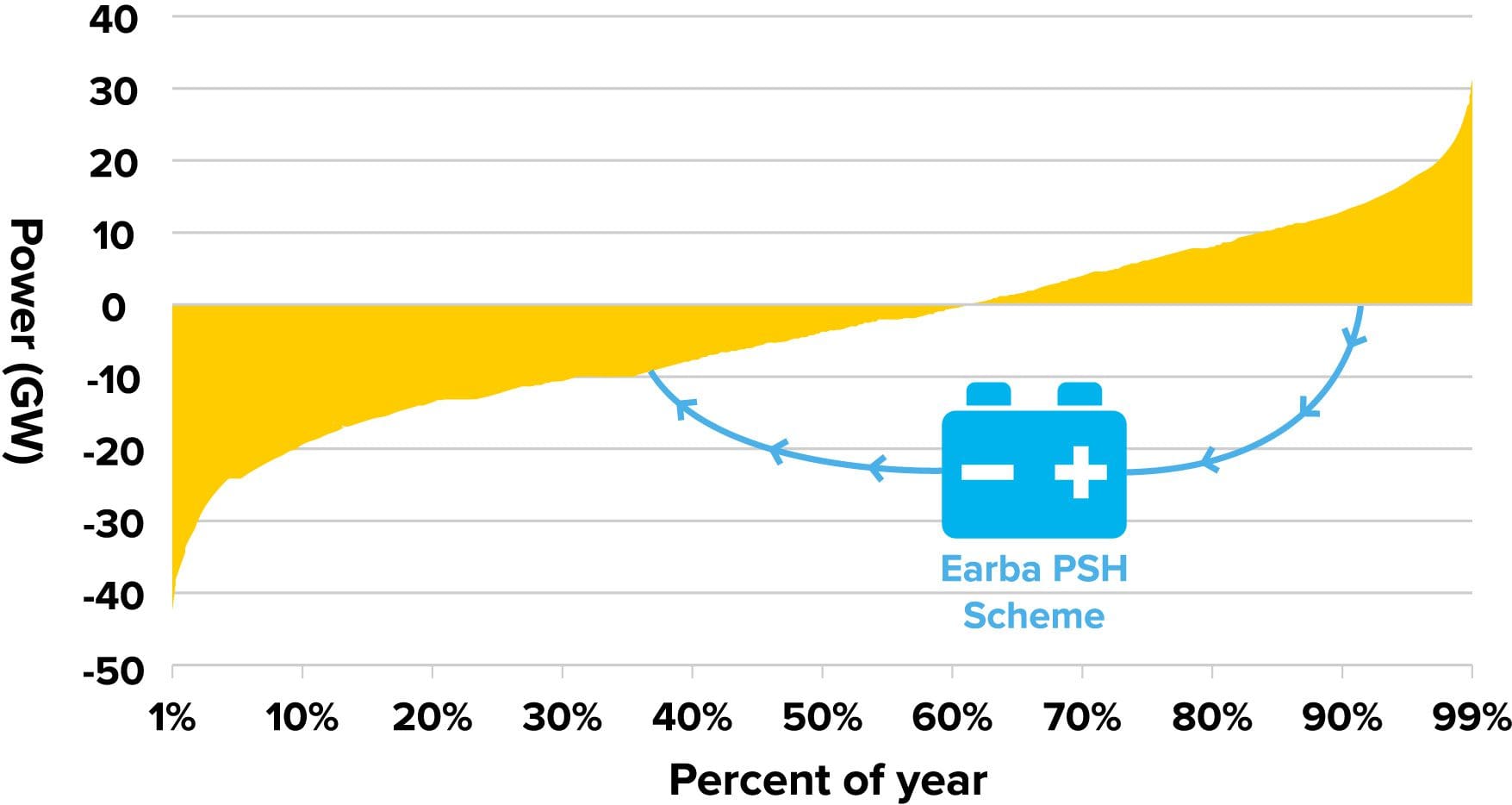
The chart above shows the potential shortfall (‘Deficit’) and excess (‘Surplus’) of renewable output on the UK electricity system by 2035.
The challenge: curtailment and reliance on gas generation
The yellow section on the left of the chart represents the annual energy shortfall - the amount of electricity demand that exceeds the supply available from low-carbon generation sources. The chart shows that, for around two-thirds of a typical year, the UK is not expected to generate enough low-carbon electricity to meet demand. The scale of this shortfall is significant, measured in terawatt hours (TWh) rather than gigawatt hours (GWh) or megawatt hours (MWh).
At present, the main solution to this gap is gas-fired generation. In 2025, the UK relied heavily on gas power stations to maintain electricity supply. However, gas generation produces carbon emissions and is subject to highly volatile fuel prices. If the UK is to reduce its dependence on gas and achieve its net zero targets, alternative sources of flexible, low-carbon energy will be essential.
The yellow section on the right of the chart represents the annual energy surplus - the amount of low-carbon electricity generated in excess of demand. The chart indicates that, for around one-third of a typical year, the UK is expected to produce more low-carbon electricity than the grid can use at that time.
Currently, much of this surplus energy is lost through a process known as curtailment. Curtailment occurs when renewable generators, mainly wind farms, are instructed to reduce or stop generation because there is insufficient demand or network capacity to absorb the electricity being produced. Wind farm operators are typically compensated for reducing output, with much of the cost ultimately passed on to consumers. As a result, curtailment is both wasteful and expensive.
The solution: Long Duration Energy Storage 'LDES'
Energy storage provides a solution to both of these challenges. It reduces wind curtailment by absorbing excess electricity during periods of surplus generation - for example by charging batteries or pumping water uphill in a pumped storage hydro scheme - and it reduces reliance on gas generation by releasing stored renewable energy during periods of deficit.
In simple terms, an energy storage project such as the Earba pumped storage hydro (PSH) scheme captures energy from periods of surplus generation, stores it, and then returns it to the grid when demand exceeds renewable supply. In doing so, it helps reduce wasted renewable energy, lowers curtailment costs, and decreases the need for carbon-intensive gas generation.
The scale of the balancing challenge is substantial. While battery storage and interconnectors form an important part of the solution, balancing the electricity system across extended periods, including weeks, months and seasonal variations, will require significant additional long-duration storage capacity. As renewable generation continues to expand rapidly, periods of excess renewable output are also expected to become more frequent and prolonged.
A typical 50MW battery storage project with a two-hour duration can store around 100MWh of energy. By comparison, the Earba PSH project is capable of storing 40,000MWh - equivalent to around 400 such battery projects. This demonstrates why large-scale, long-duration energy storage schemes such as Earba PSH will play a critical role in supporting the transition to net zero while maintaining a secure, balanced and cost-effective UK electricity system.
The Earba PSH project is one of the most attractive large-scale, long-duration energy storage developments currently being progressed in the UK, combining substantial power output with very high energy storage capacity.
See More
About Us
We are a small multi-skilled team which includes a full suite of engineering, consenting, project management, commercial, financial and legal expertise ‘under one roof’. We are straightforward to work with, deliver results and enjoy what we do.
To learn more, click the button below.